Showing posts with label Peltier cooler. Show all posts

Tuesday, February 15, 2011

A discussion about the flaws of my experiment


I talked about my experiment on a science-oriented forum yesterday and we discussed the possible flaws of my experiment. Several interesting improvements are suggested. I will post here the highlights of the other users' comments and my replies to them.

One of them wrote:
"I'm guessing you did this:
You dripped some water from your fingers directly onto the surface of the peltier device, and it froze.

You then put some water in that small beaker, and place the beaker on the surface of the device. Well, unless your device surface and beaker bottom are absolutely flat, you're going to get somewhat poor thermal conduction. You could coat the interface with some of that thermally conductive paste if you are looking for a better result. It's the same white stuff you may see between the heatsink and the junction on the other side."
True, I first dripped a couple of drops from a 10 mL medical syringe directly onto the surface. This is the most efficient method, but only allows the cooling of very small volumes.
When I tried to freeze the water in the glass beaker, the surface of the beaker is not flat and the thermal conductivity between the beaker and the cooler was poor. Thermal paste would improve the results a bit, but as the glass itself has a poor thermal conductivity, It would still be inefficient. I think a better solution would be that instead of the beaker I use a smaller container with a thin bottom and made of some material with better thermal conductivity, for example aluminium or copper. Thermal paste could be applied as well if needed.


Another point was the inefficiency of the heatsink.
"Is there a fan on the heatsink on the hot side? Are you using that fan? Is it free to move air?"
"Well if I understand your setup photo, your fan is sitting directly on the table surface. That limits its ability to move air."
There is a fan on the heatsink (that I got from an old computer lying in my attic), but a rather small one. I think it has 6 cm in diameter at most. During the experiment  the heatsink was put on top of a large tube that allowed plenty of cool air to reach the heatsink. I am looking for a better heatsink but I don't want to spend money for it, because my resources are limited.

Monday, February 14, 2011

Peltier cooler: DIY part one


So I finally got a peltier cooler from ebay last week. You can buy one for about $5 (depending on postage it could be more). I dropped some water on it while being connected to my PSU (14.5V, 23A) and it froze almost instantly. However, when I tried a larger amount of water (13 mL, a volume of one ice-cube), it never froze. The problem is in the cooler block on the other side, because it's not efficient enough. The whole system overheats after a couple of minutes.

Here is a picture of the setup of the first experiment (PSU not visible):
peltier cooler with heat sink attached
(click to view in full size)

And here is a temperature/time plot of the experiment. Note that temperature is in degrees Celsius.

temperature plot
(again, click to view in full size)

Sunday, February 13, 2011

Peltier coolers: how it all began


I was browsing youtube one day because I was annoyed with my freezer taking 2 hours to turn water to ice. I came along a lot of videos featuring so called "Peltier coolers", which amazed me instantly. For example see this video:

My current project: Peltier cooler


So a little background introduction at first. What are peltier coolers?

Wikipedia says:
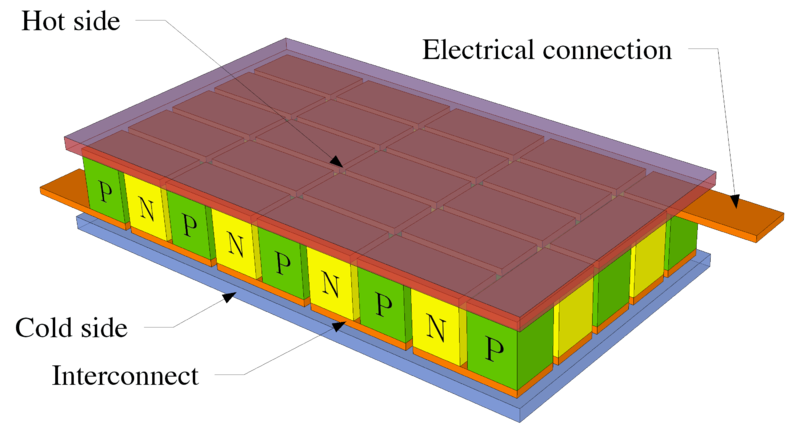
"Thermoelectric cooling uses the Peltier effect to create a heat flux between the junction of two different types of materials. A Peltier cooler, heater, or thermoelectric heat pump is a solid-state active heat pump which transfers heat from one side of the device to the other side against the temperature gradient (from cold to hot), with consumption of electrical energy. Such an instrument is also called a Peltier device, Peltier heat pump, solid state refrigerator, or thermoelectric cooler (TEC). The Peltier device is a heat pump: When DC current runs through it, heat is moved from one side to the other. Therefore it can be used either for heating or for cooling (refrigeration), although in practice the main application is cooling. It can also be used as a temperature controller that either heats or cools."
Here's a diagram of a thermoelectric cooler.

(click on the image to view labels)